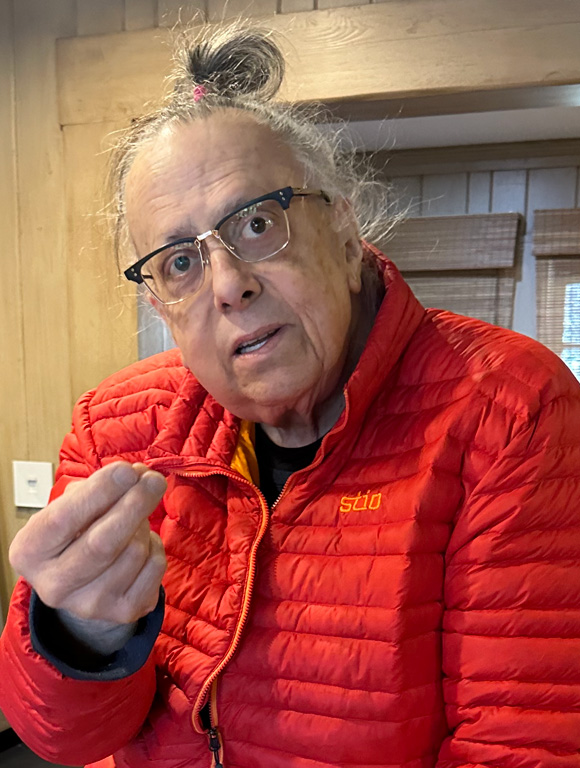
Dan Mayo was born into Tulsa royalty in 1950, a life buffered by multigenerational wealth and eccentric privilege. His maternal grandfather, C. W. Oliphant, was an Oklahoma oil baron, while his paternal grandfather, John D. Mayo—whom Dan was named after—provided him with an unlikely childhood playground: a vast, mysterious boutique hotel. As a small boy, Dan spent long hours roaming its corridors, often retreating to the luxurious penthouse his grandfather had built for himself. These early years were marked by a rare sense of freedom, adventure, and discovery. Dan was a child governed by curiosity, unafraid of wandering into the unknown.
As a teenager, that curiosity found expression in music. Dan took up the bass and became proficient quickly, surrounding himself with musicians, artists, and fellow renegades. Life felt expansive and permissive. His parents were well-known Tulsa socialites, and Dan grew up amid some of the city’s most interesting and creative people. He was close to several major Tulsa musicians, including members of the famed Clapton band of the 1970s—Carl Radle, Jamie Oldaker, and Dick Sims. He befriended the brilliant blues guitarist Steve Pryor, and he quietly supported musical projects he believed in, acting less like a patron than a fellow traveler.
Around this same time, Dan became obsessed with photography. Cameras, lenses, and processes fascinated him. He acquired a large-format Polaroid camera and began attending photography workshops across the United States, immersing himself in both the technical and intuitive dimensions of the medium. By his early twenties, Dan had developed a reputation as a gifted photographer, and at age twenty he was invited by Leon Russell to become his personal photographer. Dan toured with Russell during the legendary Mad Dogs and Englishmen tour in 1970, documenting an era of American music from inside its moving caravan. In 1971, Dan shot the iconic cover image for Russell’s critically acclaimed album Carney—a photograph that remains inseparable from the record’s mythos.
For decades, Dan’s creative life expressed itself in fits and starts, shaped by circumstance, temperament, and physical limitation. Then, sometime around 2009 or 2010, something unexpected happened. Dan’s young granddaughter, Mia, began drawing with him.
What began as play soon became something stranger and more profound. Dan owned a sizable library of expensive art books—canonical works, blue-chip artists, carefully printed and revered. Drawing with Mia, he thought it would be fun to scribble directly into these books. Without concern for artistic precedent or historical reverence, the two of them began drawing together—innocently, fearlessly, and without strategy. One of the earliest works I saw was a piece made collaboratively on a reproduction from Richard Diebenkorn’s Ocean Park series. When I first encountered it, I was struck dumb. There was something perfect and sublime about it—transcendent, unselfconscious, and alive in a way that felt wholly unforced.
Dan knew immediately that he was onto something. More importantly, he was having a blast working alongside his three-year-old granddaughter. Together they continued—scribbling, painting, drawing—moving through artist after artist, book after book. Eventually, as children do, Mia tired of the activity around age five or six. But by then, Dan was committed. Something real and meaningful had emerged, and he wasn’t finished.
Dan began working with renewed intensity, experimenting vigorously with inks, pens, nibs, colors, acetone, solvents, brushes, pencils—anything that might speak. Long possessed of a vivid imagination, he was now developing a visual language capable of plumbing emotional and psychic depths. Often he emerged with works that felt complete, whole, and unmistakably original. He found deep satisfaction in this labor.
It’s important to note that Dan did not recklessly destroy these pristine art reproductions. He revered them. He worshiped the artists whose work he intervened in, devouring their images and returning to them obsessively. Limited mobility meant Dan focused mostly on smaller works, only occasionally branching into larger formats. Haunted by his father’s accusations of being a “dilettante,” Dan approached this new work with focus, consistency, and rigor—drawing on the discipline he had once applied to photography. He worked intensively in his modest but well-equipped studio at the far end of his house, down a flight of stairs, until his knees eventually refused the journey. Gradually, his work migrated into the master bathroom he had remodeled years earlier, transforming it into an unlikely but devoted studio.
Artists like Andres Serrano and Chris Ofili are often cited as examples of transgressive art—works that scandalize by violating religious or cultural taboos. Dan’s mixed-media drawings operate in a similar territory, but with a crucial difference. Rather than transgressing religion, Dan’s work turns its offense back toward art itself—toward the sanctity of the canon. His interventions intrude upon sacred images, but always in the spirit of devotion rather than desecration.
Dan is like a decorator who breaks into a pristine house, guts it, and redecorates it without permission—out of love, curiosity, and compulsion. His work is a meditation on childlike innocence unleashed and left unattended, armed with the force of a marauder. It is playful, irreverent, intimate, and strangely tender. In these scribbles, one finds not destruction, but dialogue —between generations, between reverence and rebellion, and between a man and the long, unfinished conversation of art itself.
LESS